Japanese Giant Salamander
Andrias japonicus
Photo: Salamandra2021 / CC BY-SA 4.0 / Wikimedia Commons
The Japanese Giant Salamander is one of the world's largest amphibians and can grow to more than a meter in length. It is nocturnal and hides in rock crevices of clean rivers, feeding on fish, freshwater crabs and other prey. Endemic to Japan, the species is a Special Natural Monument, and habitats in Gifu, Okayama, Oita and elsewhere are also designated Natural Monuments.
- Scientific name
- Andrias japonicus
- Group
- Amphibians
- Prefectures
- Gifu, Mie, Hyogo, Tottori, Shimane, Okayama, Hiroshima, Oita
- Japanese Red List (Ministry of the Environment)
- VulnerableMinistry of the Environment 5th Red List (2026)
- When to see
- August, September
- 日本語
- オオサンショウウオ
- 简体中文
- 日本大鲵
Sign in to record the animals you meet in your private journal and to post photos and comments. Browsing needs no account.
Sign inNatural Monuments related to the Japanese Giant Salamander
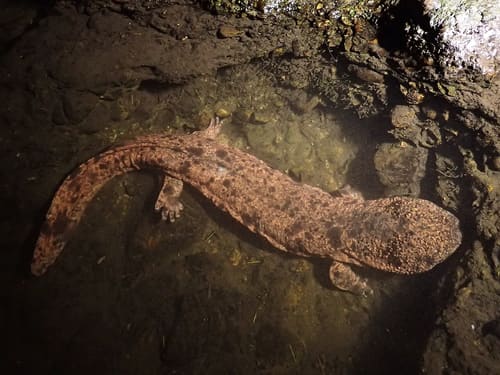
Where to see the Japanese Giant Salamander
Facilities whose official websites show this animal on display. Exhibits can change, so check each facility's latest information before you go.
When to see
- 1
- 2
- 3
- 4
- 5
- 6
- 7
- 8
- 9
- 10
- 11
- 12
A large river-dwelling amphibian designated a Special Natural Monument. The breeding season is late August to September; from early August they move upstream and lay eggs in burrows in upstream riverbanks.
Exhibit sourceMap
Markers show designated habitats and breeding sites.
Loading map…
Frequently asked questions
The Japanese Giant Salamander is designated as a species without a fixed area and lives in places such as Gifu, Mie, Hyogo, Tottori, Shimane, Okayama, Hiroshima, Oita.
You can see the Japanese Giant Salamander at Aqua Totto Gifu, Hiroshima City Asa Zoological Park, Inokashira Park Zoo, Kyoto Aquarium, Ueno Zoological Gardens, among others (confirmed on each facility's official website on 2026-10-15).
The Japanese Giant Salamander is mainly seen in August, September. A large river-dwelling amphibian designated a Special Natural Monument. The breeding season is late August to September; from early August they move upstream and lay eggs in burrows in upstream riverbanks.
The Japanese Giant Salamander is listed as "Vulnerable" in the Ministry of the Environment 5th Red List (2026) (listed as オオサンショウウオ).
Animals related to the Japanese Giant Salamander
Animals in the same group or designated in the same area.
Community photos
Sign in to post and share photos and comments about the animals you meet.
Comments
No comments yet.